Friday, February 8, 2008

Communicative language teaching methodology

Soon to come: A description of communicative language teaching methodology

Friday, January 11, 2008

The Sounds of Language, Part 3

Now that we've considered the vowels and consonants, what else could possibly be phonemic? What else can make a difference in meaning?

Just tell me why I would want to subject you to that subject?
Children whose conduct is exemplary conduct themselves well at all times.
Do you buy your produce in stores that produce many happy customers?
If you contract a mental disease, are you allowed to enter into a contract?
I'd like to present you with a present.
You can compare and contrast items only if there is a meaningful contrast between them.
The gentlemen on a protest demonstration protest their innocence too loudly.
An invalid may vote, and his/her vote will not be invalid.
The striking garbage collectors refuse to pick up the refuse.

I hope you get the point. Changing the stress from one syllable to another has the power to change the meaning of the word. Thus, we see that in English, stress is definitely phonemic. On the other hand, Hungarian is a language in which the stress always falls on the first syllable, no matter how long the word. So in that language, stress is not phonemic at all. It cannot change the meaning of a word.

Many people study Spanish and are familiar with its accent marks. Those little marks occurring above vowels tell us that one syllable is stressed more strongly than the others in the same word. If you shift the stress from one syllable to another, you might wind up with a nonsense word; or you might you might change the word's meaning in some way. For example, "hablo" is stressed on the first syllable, and means "I speak." "habló", on the other hand, stresses the last syllable and means "he/she/you spoke." "hable" is a command, meaning "speak!" "hablé" is a past tense, meaning "I spoke." "ingles" (stress on the first syllable) means "intestines, guts," "inglés" (stress on the last syllable) means "English." Changing the stress has the power to change the tense and the subject of the verb simultaneously, or, in the latter example, the complete meaning of the word. Thus, we have demonstrated that stress is phonemic in Spanish.

Stress is called a suprasegmental feature in a language. If stress can be proven to be phonemic, we then need to label suprasegmental phonemes separately from segmental ones (i.e., the consonants and vowels).

Can anything else be phonemic?

As a matter of fact, yes. The TONE of a word. To some extent, tone in English can be phonemic, but not in the same way that it is phonemic in Chinese. In English, if the TONAL CONTOUR shifts, it can create a difference in how the sentence is to be interpreted. We'll look at tonal contours in another posting. For the sake of this one, we'll assume that tone in and of itself is not really phonemic in English. However, tone is very much a phonemic reality to be reckoned with in all the Chinese languages and in others such as Zulu and many Native American languages.

A Mandarin word can be pronounced with one of four different tones. Each tone alters the word's meaning so that the same segmental phonemes pronounced in the different tones can mean mother, hemp, horse and also be used to indicate that what was just said is a question. That word is /ma/. With the suprasegmental toneme marker placed above the vowel, it could be /mā/ (first, or high tone), /má/ (second, or rising tone), /mă/ (third or falling-rising tone), /mà/ (fourth, or falling tone). Ma (with no tone markings) is termed a neutral tone. You can see that mother, hemp, horse and a grammatical indicator of interrogation have absolutely nothing to do with one another. One more fascinating example in Mandarin is that /măi/ means "buy" and /mài/ means "sell." You can really get into trouble if you confuse those two! That's the power of tone in Mandarin!

Cantonese is even more complex with its nine tonemes.

Zulu's two tones seem to be relegated to the personal pronouns. If a verb is pronounced with one tone, then the subject is "you;" if with the contrasting tone, then the subject is he/she. So tone is much more limited in its use in that language.

Consonants, vowels, stress and tone - these are the relevant distinctive features that make up the phonology of the languages of the world. In a future posting, we will begin to see how phonemes, though devoid of meaning on their own, combine to form particles - pieces of words which linguists call MORPHEMES, and that these little pieces, though they don't exist in isolation, are of vital importance in making up the longer units, the units we call "words."

Feel free to comment, query or add to any point made in this and other postings on this blog.

Sunday, January 6, 2008

Silent letters - a challenge

How many letters in the English language alphabet can be silent? For example: b is silent in "doubt." g is silent in "gnome." How many letters of the alphabet are never silent? Which ones are they? I have no fixed answer to this question at the moment - Whenever you have a free moment, start working on this, and post your answers as comments to this posting. At the start of this project, I will publish only the answers given by members of The Linguistics Club in my school. All others may submit responses, too, but I shall not publish them until all my students have exhausted their guesses. Then, if any others in the world at large can do better, those suggestions will be added at the end. Please provide at least one example for each letter in your submissions.

Friday, January 4, 2008

The Sounds of Language, Part 2

In a previous post, we examined the consonantal phonemes of English and learned that phonemes are the smallest significant units of sound in a language. Let's take this statement apart a bit. Just what do I mean by the phrase "smallest significant unit of sound"?

First of all, let's be sure to distinguish between an alphabetic letter and a phoneme symbol. p is a letter of the alphabet. /p/ represents the sound made by pressing the lips together firmly, building up air pressure in the mouth and then opening the lips to expell the air silently without the vocal cords vibrating. But how exactly do we pronounce that sound? Take the word "pin" for example. Go ahead - say the word. Now do the following: Hold your hand very close to your mouth as you say "pin." You will feel a puff of air leave your lips as you say the /p/ sound.
Now, say the word "spin." Again, hold your hand very close to the front of your mouth. Do you feel a difference? Is there less air being expelled? If you're not sure, then hold a thin piece of paper close to your lips and say "pin" and then say "spin." In each case you will see the paper move a lot as you say "pin" and the paper hardly moves at all when you said "spin." You have made two very different kinds of "p" sound. The "p" of "pin" was accompanied by an audible puff of air. You can hear it if you listen for it. We don't usually listen for these details because they carry no meaning for us. But that puff is definitely there, and it is definitely absent when you say "spin." The p with the puff of air is called an aspirated voiceless bilabial stop. The p without the puff of air is called an unaspirated voiceless bilabial stop.

So linguists deduced back in the 19th century that the phoneme /p/ had more than one pronunciation. You have now seen two variants. One was symbolized [ph], the h being written as a superscript letter to the right of the p, and the other was symbolized [p=], with the = sign written as a superscript to the right of the p.

So, phonemically, the word was represented as /pIn/, while phonetically it is written as [phIn], and the word {spin} was written phonemically as /spIn/, but phonetically it was written as [sp=In]. So you can see that the phonemic spelling doesn't tell you much about the pronunciation, while the phonetic spelling does.

Linguists realized that the reason that the puff of air (known more properly as "aspiration") disappeared if the phoneme /s/ preceded it. They were now able to make an interesting statement. They said that the phoneme /p/ had two pronunciations. It was pronounced [p=] after /s/, but [ph] everywhere else.

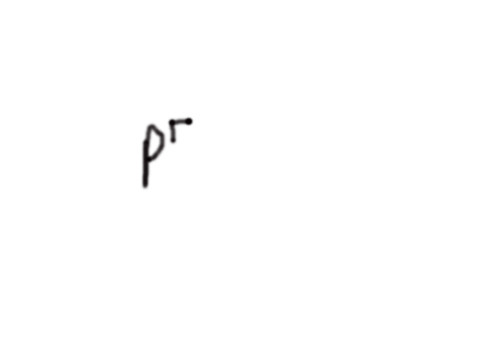
The sounds [ph] and [p=] are not really perceivable to normal non-linguists. They are called "allophones of the phoneme /p/". The prefix "allo-" comes from Greek and means "another," so "allophone" actually means "another sound." Allophones are the different slight variants in how a phoneme is pronounced. Actually, there are more allophones for /p/ than those I have just described. There is the "unreleased" variant that occurs when we say the word {stop} or {apt}. We don't even open our lips right after we've said the sound. So, in word final position, or when followed by a voiceless stop consonant, we say that /p/ manifests itself as the unreleased allophone [p] (followed by a symbol that cannot be reproduced normally in this blog. It is a small superscript line drawn upward and then sharply to the right, looking like a small right angle -
click here to see the symbol properly drawn.

To sum up, most phonemes in most languages are pronounced differently in different phonemic environments, and the job of the linguist is to specify exactly how to pronounce each phoneme in each environment. The allophones are said to be in "complementary distribution," a fancy way of saying that the phoneme consists of several different ways of saying it, and that if you take all those slight variants all together, they add up to the full phoneme. It's sort of like the old idea in geometry of complementary angles. If one angle is 20 degrees, its complementary angle has to be 70 because together they add up to the full right angle of 90 degrees. However, in linguistics, the allophones all add up to be the full description of all the ways to pronounce the phoneme.

In Mandarin, aspiration isn't an insignificant detail. The contrast between /pho/ and /p=o/ creates two entirely different words. So, in Mandarin, aspiration is phonemic. It's important. /ph/ and /p=/ are not mere allophones of a master phoneme. They are not in complementary distribution. Each is a full phoneme in its own right, capable of differentiating meaning.


Pairs such as /pho/ and /p=o/ are called "minimal pairs." If you can find two words identical in every respect but one, then the sounds that are NOT the same are separate phonemes, because they prove that those two sounds can contrast with each other meaningfully.

So now comes the big question. How many vowel phonemes are there in English, and what are they? How are they represented?

Again, we have to ignore conventional spelling. Whenever we want to describe a word in its conventional spelling, we place it between brackets as in the following example: {peat}.

Pronounce the word {Pete}. It sounds the same as {peat}. Phonemically, both are written as follows: /pit/. The letter /i/ represents the vowel sound that you hear in the name {Pete}. It is the same vowel sound that we hear in the words {speak}, {eat} and {Greek}. The trouble with conventional spelling is that you can spell the sound /i/ several different ways. It's confusing. But phonemic spelling never carries confusion along with it. If you see an /i/, you pronounce it as if it were the {-ee-} of the word {Greek}.

Minimal pairs can prove that there are actually 15 vowel phonemes in English. Here they are, with minimal-pair examples to show how they are pronounced:

i (as in "Pete") /pit/
I (as in "pit") /pIt
e (as in "pate") /pet/
ε (as in "pet") /pεt/
æ (as in "Pat") /pæt/
a (as in "pot" /pat/
^ (should be a full size wedge shape), (as in "cup") (always stressed) /k^ p/
∂ (as in the first syllable of "about") /∂baUt/
כֿ (as in "caught") (omit the little line above the letter) /kכֿt/
o (as in "coat") /kot/
U (as in "pull") /pUl/
u (as in "pool") /pul/
כֿ I as in "boy" /bכֿ I /
aU as in "bough" /baU/
aI as in "by" /baI/

The last three vowels are glides. They begin with one vowel and end by gliding smoothly to the final vowel. They are sometimes also called "diphthongs" because they are two vowels pronounced so integrally together that they behave as if they were a single phoneme. Often a small upward circular line is placed under the second vowel to indicate that a glide is involved.

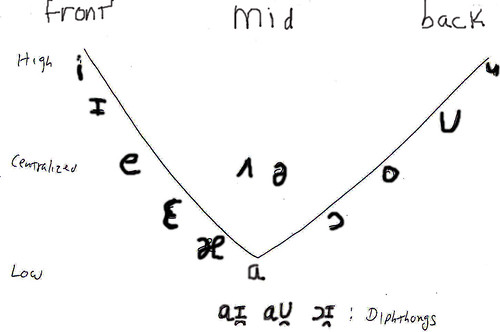
Vowels are called "front vowels" if they are made in the front of the mouth, "mid vowels" if made in the middle of the mouth, and "back vowels" if they are made in the back of the mouth. The diagram of the vowels is schematically drawn to show that they are front, mid or back, as well as if they are "high", "centralized" or "low. " This diagram is called the
vowel triangle. Please click on this link to see it.

What do we mean by "front vowel", "mid-vowel" and "back-vowel"?

It has to do with where the main mass of the tongue is placed as you create the vowel. You've probably never realized it, but where the tongue is in the mouth determines how the vowel sounds to the human ear. If you wish to create the sound of /i/ is in {speak}, the main mass of the tongue moves toward the front of the mouth and is also rather high in the mouth. To make the sound of /u/, the tongue is also rather high, but it moves toward the back of the mouth. To see this for yourself, make the vowel sounds /i/ and /u/ rapidly one after the other and sense how your tongue moves back and forth. After doing that a few times, make the sound of /a/ as in {gone}. Note that the mouth is much more open, that the "hump" of the tongue is midway between front and back, and that it is lower in the mouth than when you said /i/ or /u/. These three vowels are the cardinal points in the vowel triangle: high front, low mid, and high back. Again, look at the
vowel triangle to see this visually.

In a future posting, we'll look at suprasegmental phonemes; that is, phonemes that are neither consonants nor vowels, but rather syllable stress and tone. Can differences in tone create major differences in meaning?

Please post any questions or comments in the comment section immediately following this post.


Sunday, December 30, 2007

Jealousy and Envy - Their effects upon the growth and development of the English language

Jealousy and envy - two very mean qualities that percolate through human history also populate the languages of the world with their lexical droppings. Let's take a look at English as a benefactor of said droppings.

We have to go back to the ancient Greeks to begin our story.

The Greeks were known for their love of abstract thinking, for their mythology, philosophy, mathematics, poetry and drama, as well as for their sculpture and pottery. But sculpture and pottery do not speak or leave linguistic residue; the others do - and they did.

The very words poem, poet, drama, anathema, problem, theorem, theory, myth, program, epigram, graph, telegraph, and many, many others all originated within the culture of the Greeks of the Classical period of the 5th century before the Common Era (BCE).

Then along came those nasty, bellicose Romans who swooped down upon the less militarily sophisticated Greeks, conquered them and enslaved them. However, the Romans, though superior in military prowess, envied the Greeks their culture. Into their own language the Romans began to absorb many Greek words reflecting academic and artistic sophistication.

Julius Caesar, Rome’s most famous military leader and eventual dictator, expanded the Roman Empire West all the way to Gaul (now called France), and into Iberia, the land that is now called Spain. The Roman legions also reached and conquered England, Germany and even North Africa. And into these countries they brought their Native Latin laced with many, many Greek words that they had "borrowed" from their defeated Greek enemies.

The inhabitants of Spain and France had to try to learn Latin in order to communicate with their new masters. They didn't do too good a job at it.

The inhabitants of Spain originally spoke a language we call Celtiberian. To speak with their new Roman overlords, they had to speak Latin, and they did so very poorly with a heavy accent derived from their own Celtiberian language. This poorly learned Latin is what eventually metamorphosed into modern Castilian Spanish. But Spanish also absorbed those Greek loan words right along with the ordinary Latin ones. So, modern Spanish now has a cornucopia of words that derived from the Greek. Words such as drama, problema, telegrama, poema, mapa, papa (meaning "Pope"), poeta, dentista, oculista, artista and many, many others became standard Spanish.

So what does all this have to do with English? Does it have anything to do with an interaction between the English and the French? Absolutely!

In fact, the very same thing that happened in Spain happened in France. Latin vocabulary, which included all those new Greek words, were imposed upon the inhabitants of France who also had to speak Latin, and spoke with the accent of the Gaulish people who had originally been there prior to the onslaught of the Romans. However, England had its own problems with France. The French, like the Romans, were quite skillful at warfare and in 1066 William the Conqueror, also called the Duke of Normandy, overcame all English resistance and defeated and then inhabited their land. The English, though defeated by the French, nonetheless were jealous, and envied them for their intellectual and cultural achievements and perceived superiority, especially in the areas of philosophy, perfumes and the culinary arts (note: culina is the Latin word for "kitchen.") Are you starting to get the connection?

Just as the Roman aristocracy had borrowed hundreds of words from Greek in order to make their speech sound more sophisticated than that of the "lower classes," the English aristocracy, who by that time were speaking a form of English that we now call "Middle English," began to do the same thing - borrowing hundreds of French words which soon became part of the English language (note: the very word language is a French loan word). That is one of the ways that so many Greek and Latin based words crept into the English language.

I hope that none of you think that English derived directly from Latin. Nothing could be further from the truth. As you may have read in a previous posting, the languages that grew from Latin are called the Romance Languages, and they include Spanish, French, Portuguese, Italian and Rumanian. The languages that sprang from Germanic included Anglo-Saxon, which consisted of various dialects. One of them was spoken in an area of England called Mercia. It is the Mercian dialect of Anglo-Saxon that developed into Middle English which then developed further into the Modern English you and I speak today. Any Latin or Greek-based words that occur in English came in through borrowings from French, Spanish and, in some cases, Italian.

The previous account is just part of the story of how Latin came to occupy such an important place in the English language. But our story is not quite complete just yet.

Later on in the history of our language, scientists decided to borrow scientific vocabulary straight from Latin in order to name plants, animals, and the full anatomy of the human body.

Why Latin?
Good question!

The Catholic Church had been spreading Christianity around the world, and had been doing so in Latin. Here's why: The early Christians had first translated the Hebrew Bible into Greek in order to win the Greeks away from their "pagan" tradition of myth-belief. Then, after the Romans had established their place as the new force to be contended with, the Bible was then retranslated - from the Greek into Latin in order to convert the inhabitants of the Roman Empire. Since Roman culture outlasted Greek culture, Latin became the common language of the church. Anyone with education studied languages - especially Latin, and all philosophy and other learnèd subjects were written in it rather than in the author's native language. A French scholar, an English scholar, a Dutch scholar, a Danish or Russian or Swedish or Norwegian scholar would write in Latin. That way, no matter what the native language of the scholar, all scholars the world over would have access to the writer's research and theories. Nowadays, because so much research is done in English, and so many Graduate school textbooks and millions of scholarly papers are written in English, our own language has now overwhelmed Latin as the "Lingua Franca" of scholarship. Latin is studied for its cultural and historical value much more than as a requirement for entree into the world of letters and scholarship. But that is actually a topic for a later posting. Back to the main line of our story:

As medicine developed, the names of all the parts of anatomy were also written in Latin. As the natural sciences developed, all the flora and fauna of the world were also given Latin names. So this, then, was another mechanism by which Latin crept into the English language. You flex your biceps, triceps, pectorals; a person has a coronary attack; you injured your patella. You fractured your tibia and your fibula. You ask a friend to scratch your scapula when it itches you. If you are punched in the solar plexus you find yourself gasping for air.

All in all, mainly because of French, 60% of the 10,000 most frequently used words in the English language are derived ultimately from Latin. The old Anglo-Saxon words that were there originally have either been relegated to second place, or had their meaning altered in some fashion or were replaced entirely.

I hope that this posting has clarified one over-arching truism: There are no "pure" languages. Languages constantly absorb lexicon (vocabulary) from neighboring languages, either due to the "vices" of jealousy and envy, because of warfare, or on account of admiration of a perceived superior culture, or, like such words as "chocolate" which derives from Aztec chocolatl, the discovery of a particular plant or food native only to a particular country.

In another posting at some time in the future, we may look further into the many, many languages that contributed vocabulary to English and the kind of vocabulary items each language contributed.


urchinTracker();

Saturday, December 29, 2007

So how did all those words from other languages get into English anyway?

Jealousy and envy - two very mean qualities that percolate through human history also permeate the languages of the world with their lexical droppings. Let's take a look at English as a benefactor of said droppings.


We have to go back to the ancient Greeks to begin our story.


The Greeks were known for their love of abstract thinking, for their mythology, philosophy, mathematics, poetry and drama, as well as for their sculpture and pottery. But sculpture and pottery do not speak or leave linguistic residue; the others do - and they did. The very words "poem," "poet," "drama," "anathema," "problem," "theorem," "theory," "myth," "program," "epigram," "graph," "telegraph," and many, many others all originated within the culture of the Greeks of the Classical period of the 5th century before the Common Era (BCE).


Then along came those nasty, bellicose Romans who swooped down upon the less militarily sophisticated Greeks, conquered them and enslaved them. However, the Romans, though superior in military prowess, envied the Greeks their culture. Into their own language the Romans began to absorb many Greek words reflecting academic and artistic sophistication.


Then along came Caesar who expanded the Roman empire West all the way to Gaul (now called France), and into Iberia, the land that is now called Spain. The Roman legions also reached and conquered England, Germany and even North Africa. And into these countries they brought their Native Latin laced with many, many Greek words that they had "borrowed" from their defeated Greek enemies.


The inhabitants of Spain and France had to try to learn Latin in order to communicate with their new masters. They didn't do too good a job at it.


The inhabitants of Spain originally spoke a language we call Celtiberian. To speak with their new Roman overlords, they had to speak Latin, and they did so very poorly with a heavy accent derived from their own Celtiberian language. This poorly learned Latin is what eventually metamorphosed into modern Castilian Spanish. But Spanish also absorbed those Greek loan words right along with the ordinary Latin ones. So, modern Spanish now has a cornucopia of words that derived from the Greek. Words such as drama, problema, telegrama, poema, mapa, papa (meaning "Pope"), poeta, dentista, oculista, artista and many, many others became standard Spanish.


So what does all this have to do with English? Does it have anything to do with an interaction between the English and the French? Absolutely!


In fact, the very same thing happened in Spain happened in France. Latin vocabulary, which included all those new Greek words, were forced upon the inhabitants of France who also had to speak Latin and spoke with the accent of the Gaulish people who had originally been there prior to the onslaught of the Romans. However, England had its own problems with France. The French, like the Romans, were quite skillful at warfare and in 1066 William the Conqueror, also called the Duke of Normandy, overcame all English resistance and defeated and then inhabited their land. The English, though defeated by the French, nonetheless were jealous, and envied them for their intellectual and cultural achievements and perceived superiority, especially in the areas of philosophy, perfumes and the culinary arts (note: culina is the Latin word for "kitchen.") Are you starting to get the connection?


Just as the Roman aristocracy had borrowed hundreds of words from Greek in order to make their speech sound more sophisticated than that of the "lower classes," the English aristocracy, who by that time were speaking a form of English that we now call "Middle English," began to do the same thing - borrowing hundreds of French words which soon became part of the English language (note: the very word language is a French loan word). That is one of the ways that so many Greek and Latin based words crept into the English language.


I hope that none of you think that English derived directly from Latin. Nothing could be further from the truth. As you may have read in a previous posting, the languages that grew from Latin are called the Romance Languages, and they include Spanish, French, Portuguese, Italian and Rumanian. The languages that sprang from Germanic included Anglo-Saxon, which consisted of various dialects. One of them was spoken in an area of England called Mercia. It is the Mercian dialect of Anglosaxon that developed into Middle English which then developed further into the Modern English you and I speak today. Any Latin or Greek-based words that occur in English came in through borrowings from French, Spanish and, in some cases, Italian.


The previous account is just part of the story of how Latin came to occupy such an important place in the English language. But our story is not quite complete just yet.


Later on in the history of our language, scientists decided to borrow scientific vocabulary straight from Latin in order to name plants, animals, and the full anatomy of the human body.


Why Latin?

Good question!


The Catholic church had been spreading Christianity around the world, and had been doing so in Latin. Here's why: The early Christians had first translated the Hebrew Bible into Greek in order to win the Greeks away from their "pagan" tradition of myth-belief. Then, after the Romans had established their place as the new force to be contended with, the Bible was then retranslated - from the Greek into Latin in order to convert the inhablitants of the Roman empire. Since Roman culture outlasted Greek culture, Latin became the common language of the church. Anyone with education studied languages - especially Latin, and all philosophy and other learnèd subjects were written in it rather than in the author's native language. A French scholar, an English scholar, a Dutch scholar, a Danish or Russian or Swedish or Norwegian scholar would write in Latin. That way, no matter what the native language of the scholar, all scholars the world over would have access to the writer's research and theories.


As medicine developed, the names of all the parts of anatomy were also written in Latin. As the natural sciences developed, all the flora and fauna of the world were also given Latin names. So this, then, was another mechanism by which Latin crept into the English language. You flex your biceps, triceps, pectorals; a person has a coronary attack; you injured your patella. You fractured your tibia and your fibula. You ask a friend to scratch your scapula when it itches you. If you are punched in the solar plexus you find yourself gasping for air.


All in all, mainly because of French, 60% of the 10,000 most frequently used words in the English language are derived ultimately from Latin. The old Anglosaxon words that were there originally have either been relegated to second place, or had their meaning altered in some fashion or were replaced. entirely.


I hope that this posting has clarified one over-arching truism: There are no "pure" languages. Languages constantly absorb lexicon (vocabulary) from neighboring languages, either due to the "vices" of jealousy and envy, or because of admiration of a perceived superior culture or because of warfare.


In another posting at some time in the future, we may look further into the many, many languages that contributed vocabulary to our rich language and the kind of vocabulary items each language contributed.


urchinTracker();

Monday, December 24, 2007

The sounds of language

Aaron's comment reveals a depth of background that it would probably be wise to begin to share with you now.


Language is a social instrument. It unites people in their own and other communities and has the potential to unite generations by linking our predecessors' histories with our own. However, for language to even get off the ground, human beings had to be able to make sounds, and to control those sounds with their breathing, and with the various parts of their mouths: their tongue, lips, teeth, and vocal cords. They invented words which were symbolic representations of objects, qualities, actions, ideas and abstractions. And these words consisted of sounds all originating from either the mouth or the nose. Some of those sounds were made by stopping the air momentarily (as in p, t, k, b, d, g), or in creating friction, such as f, th, s and sh, or by using the vocal cords as in m, n, ng, b, d, g, l, r, z, zh, j, y, and all the vowel sounds, or by silencing the vocal cords as in p, t, k, f, s, sh, th, and h.


Some languages developed over 45 different sounds that could be combined to make words, while others developed only 15 (Hawaiian) or even as low as 7 (as in Piraha). Some languages utilized vocal tone to differentiate between words, and some created a sudden puff of air right after a consonant to distinguish one word from another.


All these meaningful sounds that have the power to differentiate words from one another are called phonemes. They are the minimal significant units of sound in a language. Whenever linguists talk about the phonemes of a language, they write the phoneme symbol between forward slashes as in /p/, /t/ and /k/.


With the passage of time, some cultures felt it important to record their stories or their history in some fashion. Some drew beautiful paintings on the insides of caves; others painted on vases; and others created elaborate writing systems.


As cultures developed through history, many invented writing systems in which symbols represented whole words. So there were as many symbols as there were words. Such is the case in Chinese to this very day. Ancient Egyptian hieroglyphic writing was also symbolic in this same way, although some of the symbols carried sound value only - symbolizing syllables or just single phonemes. But to be able to read Ancient Egyptian, one has to know thousands of these hieroglyphs.


In the case of Egyptian writing, the written language gradually simplified to Hieratic writing, then to Phoenecian. By this time it was an alphabet. The very best alphabet would be one in which each letter represented one and only one phoneme. To say the least, English is not a good example of such an alphabet. Spanish is a bit truer to the idea, but even there, the letters {c}, {s} and {z} can all represent the same sound, and to confuse the issue even more, the letter {c} can be pronounced like the /s/ or like a /k/. Add to that, the {qu} is only pronounced like a /k/. Most alphabets contain inconsistencies such as these. The reasons for those inconsistencies will be discussed at a later time.


The Hebrew alphabet, as well as the Greek, Arabic and our very own all descended from that old Hieratic writing system. The important thing to remember is that spoken language came first. Writing is not language; it only reflects it.


You are free to stop here and take a break, or, if you have real staying power, by all means carry on. We'll now get a bit more specific.


What are the phonemes of the English language? How many are there?


Linguists like to present the "phonemic inventory" in chart form. The chart is actually symbolic of the inside of the mouth. Consonants made in the front of the mouth appear at the left; those made at the back of the mouth appear at the right; those made by the lips approaching each other or touching each other are called bilabial. Examples: /p/, /b/, /m/.


If they are made by the lower lip touching the upper teeth, they are called labiodental. Examples: /f/ and /v/.


If made by the blade of the tongue touching the upper teeth, they are called interdental. Examples /θ/ (pronounced {th} as in {thigh}), and /Þ/ (pronounced {th} as in {thy}).


Those made by the tongue touching or approaching the gum ridge just behind the upper teeth are called alveolar because that ridge is called "the alveolar ridge." Examples: /s/ and /z/.


The phonemes /l/ and /r/ are called liquids because in many languages /l/ evolves into /r/ and /r/ evolves into /l/. They seem to flow back and forth. However, the /l/ is usually pronounced by the tongue allowing air to escape from its sides, so it is called a lateral phoneme. The /r/ is formed in English by the tongue folding back on itself and then flipping forward. The action of flexing back and forth is called "retroflexing" and the /r/ is called a retroflex consonant.


Sounds that emanate through the nasal region are called nasals. Examples: /m/, /n/ and /ŋ/ as in {gong}


Sounds that emanate through only the mouth are called oral.


Sounds made by the mid-section of the tongue touching the area of the mouth behind the alveolar ridge, but in front of the upper palate, are called alveolopalatal. Examples: /š/ as in {hush} and /ž/ as in {beige} and {leisure} (Those last two words are a great example of what I was talking about above when I said that the English writing system is very far from the ideal of one symbol to one phoneme.). Also, the phonemes /č/ (as in {choke}and /ĵ/ as in {joke} are formed in the same area. Because they start out as stop phonemes, but end up with a bit of friction, they are called affricates. Some linguists prefer to symbolize them as follows: /tš/ and /dž/.


Behind the hard palate is a region of the mouth called the velic or velum. That is where we form the /g/, /k/ and /ŋ/. They are called velar consonants.


How far back in the mouth can we go? In Arabic there are faucal which include the uvular and pharyngeal consonants, as well as sounds originating in the glottis (the vocal folds) called glottals. The word comes from the Latin word for "throat." The very back of the tongue stops the air against the back of the throat and produces the sound represented in transliteration by the letter {q} as in {Aqaba}


The symbol /h/ represents a voiceless exhalation of air with a minimum of friction. It emanates from the glottis (the area where the vocal cords are located), and so is called a glottal phoneme.


That leaves us with just two more phonemes. They sometimes seem to be vowels and sometimes consonants, so they are called either semi-vowels or semi-consonants. /w/ is the bilabial semi-consonant, and /j/ (as in {young} is the velar semi-consonant.


Sounds that emanate through the nasal region are called nasals. Examples: /m/, /n/ and /ŋ/ as in {gong}


Sounds that emanate through only the mouth are called orals.


So, to sum up, here is the phoneme chart for the English consonantal system.

vl stops ....p.................t ...............k
vd stops....b.................d................g
vl fric...........f.............θ..s..š...................h
vd fric..........v.............Þ..z..ž
vl affr ...............................tš
vd affr...............................dž
lateral............................l
retroflex.......................r
nasals.......m.................n................ŋ
semi-cons..w...............................j

key:
vl =voiceless vd = voiced
fric = fricative affric = affricate

You most likely will want to think about this and review it in detail for awhile, so I will not present the vowels yet. But as a teaser, keep this in mind: if you thought there were only 5 vowels in English, you were very sadly misinformed. There are three times that many, and you'll see the evidence for that on the next posting.


urchinTracker();