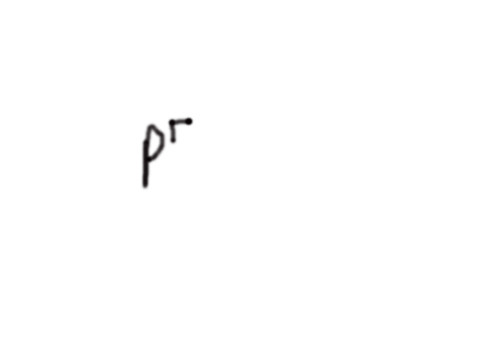
First of all, let's be sure to distinguish between an alphabetic letter and a phoneme symbol. p is a letter of the alphabet. /p/ represents the sound made by pressing the lips together firmly, building up air pressure in the mouth and then opening the lips to expell the air silently without the vocal cords vibrating. But how exactly do we pronounce that sound? Take the word "pin" for example. Go ahead - say the word. Now do the following: Hold your hand very close to your mouth as you say "pin." You will feel a puff of air leave your lips as you say the /p/ sound.
Now, say the word "spin." Again, hold your hand very close to the front of your mouth. Do you feel a difference? Is there less air being expelled? If you're not sure, then hold a thin piece of paper close to your lips and say "pin" and then say "spin." In each case you will see the paper move a lot as you say "pin" and the paper hardly moves at all when you said "spin." You have made two very different kinds of "p" sound. The "p" of "pin" was accompanied by an audible puff of air. You can hear it if you listen for it. We don't usually listen for these details because they carry no meaning for us. But that puff is definitely there, and it is definitely absent when you say "spin." The p with the puff of air is called an aspirated voiceless bilabial stop. The p without the puff of air is called an unaspirated voiceless bilabial stop.
So linguists deduced back in the 19th century that the phoneme /p/ had more than one pronunciation. You have now seen two variants. One was symbolized [ph], the h being written as a superscript letter to the right of the p, and the other was symbolized [p=], with the = sign written as a superscript to the right of the p.
So, phonemically, the word was represented as /pIn/, while phonetically it is written as [phIn], and the word {spin} was written phonemically as /spIn/, but phonetically it was written as [sp=In]. So you can see that the phonemic spelling doesn't tell you much about the pronunciation, while the phonetic spelling does.
Linguists realized that the reason that the puff of air (known more properly as "aspiration") disappeared if the phoneme /s/ preceded it. They were now able to make an interesting statement. They said that the phoneme /p/ had two pronunciations. It was pronounced [p=] after /s/, but [ph] everywhere else.
The sounds [ph] and [p=] are not really perceivable to normal non-linguists. They are called "allophones of the phoneme /p/". The prefix "allo-" comes from Greek and means "another," so "allophone" actually means "another sound." Allophones are the different slight variants in how a phoneme is pronounced. Actually, there are more allophones for /p/ than those I have just described. There is the "unreleased" variant that occurs when we say the word {stop} or {apt}. We don't even open our lips right after we've said the sound. So, in word final position, or when followed by a voiceless stop consonant, we say that /p/ manifests itself as the unreleased allophone [p] (followed by a symbol that cannot be reproduced normally in this blog. It is a small superscript line drawn upward and then sharply to the right, looking like a small right angle - click here to see the symbol properly drawn.
To sum up, most phonemes in most languages are pronounced differently in different phonemic environments, and the job of the linguist is to specify exactly how to pronounce each phoneme in each environment. The allophones are said to be in "complementary distribution," a fancy way of saying that the phoneme consists of several different ways of saying it, and that if you take all those slight variants all together, they add up to the full phoneme. It's sort of like the old idea in geometry of complementary angles. If one angle is 20 degrees, its complementary angle has to be 70 because together they add up to the full right angle of 90 degrees. However, in linguistics, the allophones all add up to be the full description of all the ways to pronounce the phoneme.
In Mandarin, aspiration isn't an insignificant detail. The contrast between /pho/ and /p=o/ creates two entirely different words. So, in Mandarin, aspiration is phonemic. It's important. /ph/ and /p=/ are not mere allophones of a master phoneme. They are not in complementary distribution. Each is a full phoneme in its own right, capable of differentiating meaning.
Pairs such as /pho/ and /p=o/ are called "minimal pairs." If you can find two words identical in every respect but one, then the sounds that are NOT the same are separate phonemes, because they prove that those two sounds can contrast with each other meaningfully.
So now comes the big question. How many vowel phonemes are there in English, and what are they? How are they represented?
Again, we have to ignore conventional spelling. Whenever we want to describe a word in its conventional spelling, we place it between brackets as in the following example: {peat}.
Pronounce the word {Pete}. It sounds the same as {peat}. Phonemically, both are written as follows: /pit/. The letter /i/ represents the vowel sound that you hear in the name {Pete}. It is the same vowel sound that we hear in the words {speak}, {eat} and {Greek}. The trouble with conventional spelling is that you can spell the sound /i/ several different ways. It's confusing. But phonemic spelling never carries confusion along with it. If you see an /i/, you pronounce it as if it were the {-ee-} of the word {Greek}.
Minimal pairs can prove that there are actually 15 vowel phonemes in English. Here they are, with minimal-pair examples to show how they are pronounced:
i (as in "Pete") /pit/
I (as in "pit") /pIt
e (as in "pate") /pet/
ε (as in "pet") /pεt/
æ (as in "Pat") /pæt/
a (as in "pot" /pat/
^ (should be a full size wedge shape), (as in "cup") (always stressed) /k^ p/
∂ (as in the first syllable of "about") /∂baUt/
כֿ (as in "caught") (omit the little line above the letter) /kכֿt/
o (as in "coat") /kot/
U (as in "pull") /pUl/
u (as in "pool") /pul/
כֿ I as in "boy" /bכֿ I /
aU as in "bough" /baU/
aI as in "by" /baI/
The last three vowels are glides. They begin with one vowel and end by gliding smoothly to the final vowel. They are sometimes also called "diphthongs" because they are two vowels pronounced so integrally together that they behave as if they were a single phoneme. Often a small upward circular line is placed under the second vowel to indicate that a glide is involved.
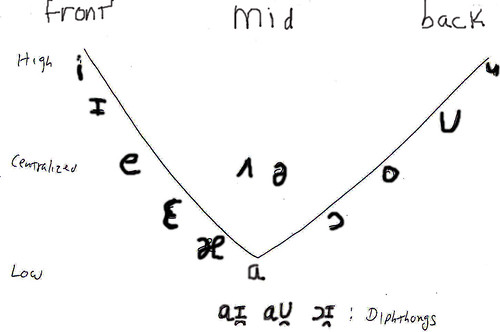
Vowels are called "front vowels" if they are made in the front of the mouth, "mid vowels" if made in the middle of the mouth, and "back vowels" if they are made in the back of the mouth. The diagram of the vowels is schematically drawn to show that they are front, mid or back, as well as if they are "high", "centralized" or "low. " This diagram is called the vowel triangle. Please click on this link to see it.
What do we mean by "front vowel", "mid-vowel" and "back-vowel"?
It has to do with where the main mass of the tongue is placed as you create the vowel. You've probably never realized it, but where the tongue is in the mouth determines how the vowel sounds to the human ear. If you wish to create the sound of /i/ is in {speak}, the main mass of the tongue moves toward the front of the mouth and is also rather high in the mouth. To make the sound of /u/, the tongue is also rather high, but it moves toward the back of the mouth. To see this for yourself, make the vowel sounds /i/ and /u/ rapidly one after the other and sense how your tongue moves back and forth. After doing that a few times, make the sound of /a/ as in {gone}. Note that the mouth is much more open, that the "hump" of the tongue is midway between front and back, and that it is lower in the mouth than when you said /i/ or /u/. These three vowels are the cardinal points in the vowel triangle: high front, low mid, and high back. Again, look at the vowel triangle to see this visually.
In a future posting, we'll look at suprasegmental phonemes; that is, phonemes that are neither consonants nor vowels, but rather syllable stress and tone. Can differences in tone create major differences in meaning?
Please post any questions or comments in the comment section immediately following this post.